
Collective efforts, policy support stressed for inclusive urban housing
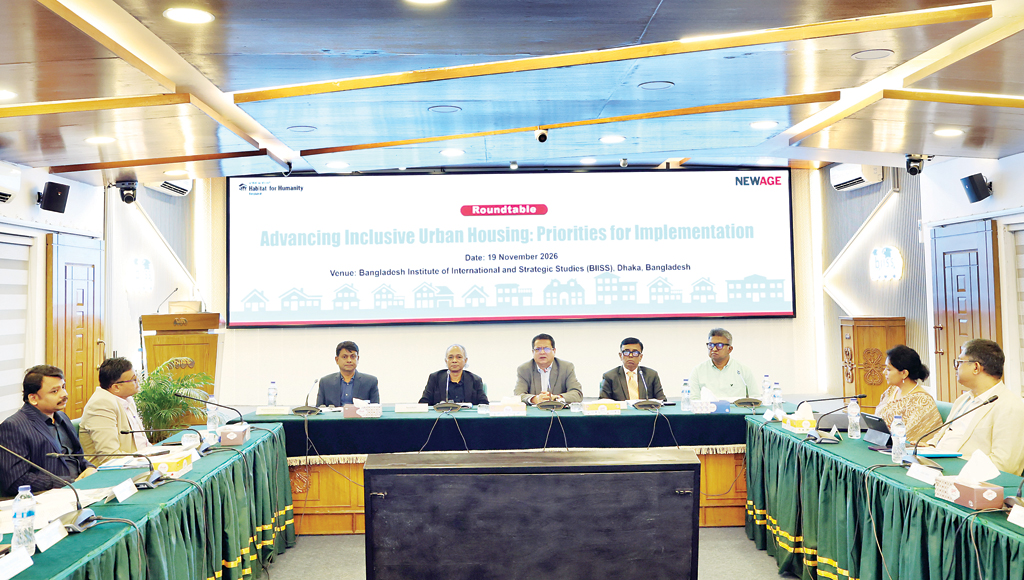
Housing and Public Works Minister Zakaria Taher and New Age Editor and Editors’ Council President Nurul Kabir, among others, attend a discussion titled ‘Advancing Inclusive Urban Housing: Priorities for Implementation’ at the auditorium of Bangladesh Institute of International and Strategic Studies in Dhaka on Thursday. | Md Saurav
19 November, 2026
Speakers including senior government officials, development professionals and academics have underscored the need for collective efforts by relevant agencies, government leadership and policy support to ensure affordable housing for low-income people in urban areas.
Addressing a roundtable in the city, they said that although several initiatives had been taken over the years, they had failed to address the problem because of inadequate planning and irregularities.
New Age and international non-government organisation Habitat for Humanity jointly organised the discussion titled ‘Advancing Inclusive Urban Housing: Priorities for Implementation’ at the Bangladesh Institute of International and Strategic Studies auditorium.
Speaking as chief guest, housing and public works minister Zakaria Taher said that the projects implemented to facilitate housing for poor people could not benefit the target population as different people bagged them.
He blamed previous governments for the failures over the years, pointing to a lack of proper planning for the country’s housing needs as a factor behind the urban crisis.
The government had adopted a 10-year plan to develop urban hubs across the country, the minister said.
‘We will create a land bank where all public land will be identified and listed so that the government can build housing for the people who need it,’ he said.
He reiterated the government’s commitment to facilitating 100,000 housing units for low-income people, adding that it was considering accommodating some of them in ongoing government projects, including Rajdhani Unnayan Kartripakkha projects in Jhilmil, Uttara and Purbachal.
New Age editor and Editors’ Council president Nurul Kabir said that although housing was a basic need, the Constitution had left its fulfilment as an aspiration for the future.
‘We admit it was difficult for the government in 1971, considering the size of the budget, but later we did not get any further commitment from successive governments to ensure shelter for all a fundamental right,’ he said while chairing the event.
He said political commitment from the government was essential to addressing people’s housing needs.
Speaking as special guest, planning ministry secretary-in-charge Kabir Ahmed said the housing sector offered significant investment opportunities, but remained neglected for long.
He said the housing ministry needed to provide strong leadership instead of continuing with ‘plot businesses’ as usual.
Local government division additional secretary Abu Nasar Mohammad Abdullah said planned development was difficult because many municipalities could not even afford to appoint an urban planner.
‘Even if the government develops facilities, the concerned municipalities cannot maintain them,’ he said, adding that some could not even pay their staff.
Habitat for Humanity Bangladesh advocacy and urban specialist Tanzia Anjum said in her keynote presentation that the National Urban Policy 2025 included a government commitment to housing for low-income people, but significant gaps remained in the implementation plan.
She stressed the need for a clear roadmap for implementing the policy, inter-agency coordination, housing finance beside availability of data for proper planning.
UNDP Bangladesh assistant resident representative Anowarul Haq said several tested models for affordable housing could be replicated if the government committed to implementing them.
Jahangirnagar University urban and regional planning professor Shammi Akter Satu said the lack of reliable data was a major obstacle to housing planning.
She said the government should develop guidelines for affordable housing. The Detailed Area Plan prepared by Rajuk mentioned affordable housing and public-private partnerships, but did not clarify how these would work, she added.
Bangladesh University of Engineering and Technology urban and regional planning professor Afsana Haque said a house was not merely a dwelling unit but an ecosystem that ensured healthy living, livelihoods and other necessities.
Bangladesh Institute of Planners president Ariful Islam said the government had prepared development plans, but failed to implement them.
‘If a plan is not implemented, it becomes worthless,’ he said, adding that Dhaka’s Detailed Area Plan had been amended three times since 2022.
He urged policymakers to prioritise rural development to reduce the flow of people into cities.
Runner Properties Ltd chief operating officer Md Abul Kalam Azad said affordable housing was not possible without low-interest loans, suggesting an interest rate of five per cent.
He criticised the Detailed Area Plan, saying it did not reflect ground realities and contained stringent provisions without effective implementation.
The speakers also raised concerns over plots allotted under the Purbachal project remaining vacant for decades despite the severe housing crisis in the capital. They urged the government to cancel allotments if plot owners failed to begin construction works without further delay.
Habitat for Humanity national director Muhammad Mahfuzur Rahman while giving the vote of thanks said some people believed the government would provide housing for everyone, but the country needed to move beyond that expectation.
New Age joint news editor Md Mustafizur Rahman, who moderated the event, said that poverty and disasters such as river erosion and landslides, among other factors, forced many people to migrate to Dhaka and other cities every year, worsening the existing housing crisis.
Sustainable finance and sustainability specialist Khondkar Morshed Millat said Bangladesh could access international climate finance by promoting green housing.
WaterAid Bangladesh climate and disaster programme lead Saief Manzoor, BIISS senior research fellow Sufia Khanom, Islamic Relief Bangladesh programme manager AM Nazir Uddin, Consiglieri Private Ltd president Kamrul Hasan and BRAC UPGP programme head Shahid Ullah also spoke at the event.
Media Covarage: https://www.newagebd.net/post/country/323235/collective-efforts-policy-support-stressed-for-inclusive-urban-housing