
HBRC White Paper “Urban Regeneration, Housing for All” Launched; Participants Call for Revitalizing Existing Cities Before Expansion
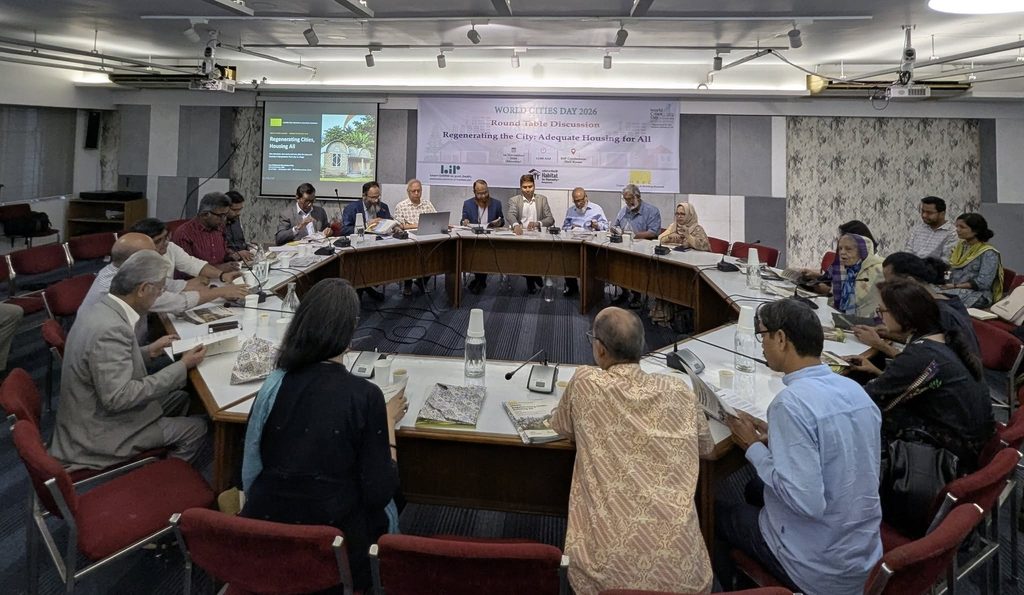
On 16 November 2026, the Bangladesh Institute of Planners (BIP), the Centre for Housing and Building Research (HBRC), and Habitat for Humanity Bangladesh (HFH-B) jointly organized a roundtable discussion at the BIP Conference Hall in Dhaka to mark World Cities Day 2026. This year’s theme was “Urban Regeneration: Adequate Housing for All.”
The discussion brought together representatives from government institutions, development partner organizations, United Nations agencies, non-governmental organizations, academic institutions, the planning profession, and the media to exchange perspectives on urban regeneration and the challenges of ensuring adequate housing for all in Bangladesh.
The event was chaired by Planner Dr. Muhammad Ariful Islam and moderated by Planner Professor Dr. Md. Musleh Uddin Hasan, General Secretary of BIP. In his opening remarks, Professor Hasan welcomed the participants and highlighted the shared commitment of the three organizing institutions to raising awareness and promoting effective initiatives for urban regeneration and adequate housing for all.
Launch of HBRC White Paper: “Urban Regeneration, Housing for All”
The highlight of the event was the unveiling of HBRC’s white paper titled “Urban Regeneration, Housing for All,” formally launched by Engineer Mohammad Abu Sadek, PEng, Executive Director of HBRC.
In his remarks, Engineer Abu Sadek explained that the white paper had been developed through a review of more than 30 research studies and publications. It examines the definition of adequate housing, measurement criteria, approaches to assessing the housing deficit, and potential solutions. He emphasized that the white paper is an ongoing initiative that will be further enriched through stakeholder feedback and validation. He encouraged participants to review the proposed definitions and measurement criteria and share their recommendations.
Key Findings and Recommendations of the White Paper
The white paper highlights significant housing challenges in Bangladesh. According to the Population and Housing Census 2022, one in every three urban households and seven in every ten rural households live in kutcha or makeshift dwellings.
It also identifies limitations in the existing approach to identifying informal settlements and housing deprivation. Bangladesh primarily follows a cluster-based approach to informal settlement enumeration, whereas the United Nations methodology considers each deprived household individually. As a result, the actual extent of the country’s housing deficit may not be adequately reflected in official estimates.
According to the white paper’s preliminary projections, Bangladesh will need to construct approximately 11.2 million to 13.5 million new homes and improve around 19.6 million existing homes between 2022 and 2030. While the demand for new housing is greater in urban areas, improving the quality of existing homes is a more pressing priority in rural areas.
The white paper proposes six measurable criteria for adequate housing, household-level enumeration of informal settlements, and separate definitions for informal settlements and encroached settlements. It also presents potential housing solutions, including ferrocement retrofitting, brick-kiln-free lightweight wall systems, and flood-resilient rural housing. The document concludes with six commitments by HBRC to advance research and action in the housing sector.
Key Discussions and Stakeholder Perspectives
During the discussion, speakers highlighted various dimensions of Bangladesh’s housing challenges, emphasizing the need for integrated planning, evidence-based policies, institutional coordination, and context-specific housing solutions.
Abdullah Al Hasan, Associate Director of Habitat for Humanity Bangladesh, emphasized that developing sustainable cities requires more than improvements in roads and infrastructure; ensuring adequate housing for everyone is equally essential. He noted that although the three organizing institutions have different areas of work, they share a common goal, which requires coordinated efforts and long-term collaboration.
Professor Dr. Mohammad Ashikur Rahman Zowardar, from the Department of Architecture at Bangladesh University of Engineering and Technology (BUET), proposed introducing a rating system for buildings based on safety, affordability, and sustainability. He suggested considering an assessment framework and certification system for the country’s approximately 41 million buildings. He also highlighted the importance of using modern technologies to address data gaps and developing locally relevant standards and definitions.
Professor Dr. Mohammad Mahbubur Rahman, a distinguished architect, urban planner, and academic, recommended incorporating financial affordability and implementation models into the white paper. He stressed that housing costs must remain aligned with people’s incomes. He also emphasized that housing should not be viewed merely as physical infrastructure, but in terms of its broader economic and social contributions, including employment opportunities, access to education, and human dignity. He further highlighted the potential of rental housing as an avenue for ensuring adequate housing.
Dr. Nabonita Islam, Associate Professor and Architect at North South University, emphasized the need to view housing beyond a standalone commodity and consider its connections with land management, employment, and livelihoods. She noted that successful housing initiatives must incorporate employment opportunities and land management considerations in the surrounding areas.
Ibnul Saeed Rana, spokesperson for the National Committee for the Protection of Nature, Biodiversity, and the Environment, highlighted the lack of coordination among government agencies in implementing development plans and the tendency to alter their original objectives. Citing river filling, unplanned infrastructure development, and increasing urbanization pressures on rural areas, he called for innovative housing models that support safe and liveable cities.
Planner Md. Nurullah, former Chief Engineer of Dhaka South City Corporation, stressed the importance of regeneration, renewal, and rehabilitation in improving existing cities. He highlighted housing as a fundamental component of urbanization and called for effective land-use zoning, the preservation of playgrounds and open spaces, and solutions to the basic challenges facing cities. He noted that effective urban planning is not possible without addressing the housing challenge.
Dr. Mohammad Maruf Hossain, Associate Professor and Architect at the Department of Architecture, North South University, explained that a ‘house’ and ‘housing’ are not the same. Housing is a broader concept encompassing land use, infrastructure, services, and social considerations. He emphasized the importance of planning for rural and urban housing based on local realities and exploring development opportunities beyond Dhaka and Chattogram. According to him, balanced distribution of facilities and resources at the local level could help reduce migration pressures on major cities.
Tazkira Khayer, Social Gender Consultant at HBRC, emphasized the importance of incorporating the needs and priorities of people of all genders into housing plans. She noted that sustainable development requires not only the construction of buildings but also participatory planning that reflects the needs of the people who will use them.
Mostafa Kayum Khan, Adviser to the Bangladesh Urban Forum, highlighted delays in formulating and implementing a national urban policy and the limited priority given to urban development. He observed that despite rapid urbanization, effective implementation of a national urban policy remains a challenge. He also pointed to the limited authority and autonomy of local government institutions as barriers to addressing urban challenges, calling for coordinated national initiatives and greater responsibilities and authority for local governments.
Planner Mahfuza Akter, Town Planner at RAJUK, described housing as a multidimensional and multi-stakeholder issue closely connected with income, land, services, and quality of life. She emphasized the need to assess housing inadequacy using Bangladesh Bureau of Statistics (BBS) data, establish common measurement standards, and set specific targets and indicators. She also recommended linking housing plans with the Sustainable Development Goals (SDGs) to strengthen their recognition in policymaking.
Engineer A. N. H. Akhtar Hossain, former President of the Institution of Engineers, Bangladesh (IEB), called for greater accountability and responsibility among local government institutions in urban and housing management. He observed that excessive centralization of governance often limits effective planning and implementation at the local level. He also recommended controlling unplanned urbanization in rural areas and considering balanced, planned housing models instead of individual plot-based development.
Mohammad Mahfuzur Rahman, National Director of Habitat for Humanity Bangladesh, emphasized the importance of viewing housing not as a commodity but as an ongoing process. He noted that providing basic services in informal settlements alone is not sufficient; integrated housing solutions are essential. He also highlighted the need to promote and scale up innovative initiatives, even within limited resources. To advance this agenda, he proposed establishing a coordinated national platform involving relevant stakeholders.
Other participants also shared valuable perspectives on the country’s housing challenges, unplanned urbanization, land management, the role of local government, and the effective implementation of development plans. Their contributions further underscored the need for coordinated and practical approaches to ensuring adequate housing for all.
Way Forward: Revitalizing Existing Cities for Housing for All
In his concluding remarks, Planner Dr. Muhammad Ariful Islam, President of BIP, thanked all participants and highlighted the shortage of reliable housing data and the limitations in implementing existing urban plans. Referring to the Detailed Area Plan (DAP), he observed that although many important provisions are included in development plans, implementation often falls short, with changes sometimes made to serve individual interests.
He further emphasized that housing is only one dimension of the broader challenges facing cities. Addressing the housing deficit must go hand in hand with integrated solutions for land use, the environment, transportation, and other urban challenges.
Participants emphasized the importance of validating the definitions, measurement criteria, and enumeration methods proposed in the white paper. They also recommended that housing planning take into account local contexts, people’s financial capacities, land management, employment opportunities, inclusive participation, and the role of local government institutions.
The discussion concluded with a shared understanding that adequate housing for all cannot be achieved without revitalizing existing cities, ensuring effective implementation of development plans, and strengthening collaboration among all relevant stakeholders. The discussions and recommendations from the roundtable will be published as an appendix to the online white paper.